Why 10-minute reduce alcohol Consistency Feels Impossible
Most people blame themselves for failing at 10-minute reduce alcohol. "I just don't have enough discipline." But consistency isn't a discipline problem—it's a systems problem. Let's break down the specific friction points sabotaging your 10-minute reduce alcohol.
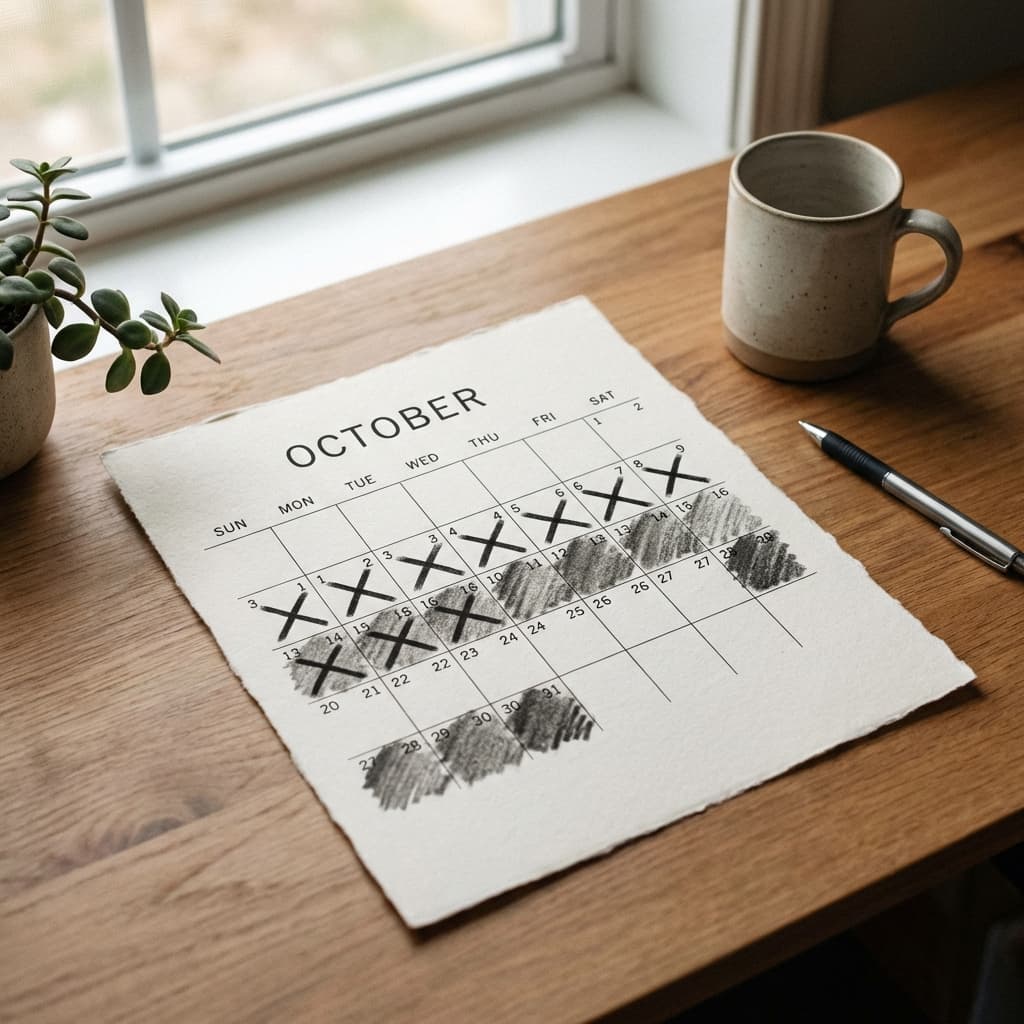
Visual tracking transforms 10-minute reduce alcohol from invisible to undeniable
The 7 Mistakes Sabotaging Your 10-minute reduce alcohol Consistency
You're not failing at 10-minute reduce alcohol because you're lazy or undisciplined. You're failing because you're making one (or more) of these strategic errors. The good news? Each one has a specific fix.
1Starting with Hour-Long 10-minute reduce alcohol Sessions
You decide to 10-minute reduce alcohol for 60 minutes daily. Day 1 feels great. Day 2 you're sore. Day 3 you skip "just this once." By day 7, you've quit. The fix: Start with 5-10 minutes of 10-minute reduce alcohol. Build the HABIT first, intensity second.
2Choosing Inconvenient Locations or Times
You pick a gym 30 minutes away because it's "the best one." Or you commit to 5 AM 10-minute reduce alcohol when you've never been a morning person. Friction kills habits. Make 10-minute reduce alcohol SO convenient you'd feel stupid NOT doing it.
3Following Someone Else's 10-minute reduce alcohol Routine
You copy a fitness influencer's workout plan, hate every second, and conclude "10-minute reduce alcohol isn't for me." Wrong. THAT VERSION of 10-minute reduce alcohol isn't for you. Find a form of 10-minute reduce alcohol you actually enjoy, or you'll never stick with it.
4Waiting for Motivation
"I'll start 10-minute reduce alcohol when I feel motivated" is code for "I'll never start." Motivation is a result of action, not a prerequisite. The secret: Do 10-minute reduce alcohol BEFORE you feel like it, and motivation shows up afterward.
5Quitting 10-minute reduce alcohol Completely After Missing 3 Days
You miss Monday. Then Tuesday. By Wednesday you think "I've already ruined my streak, so what's the point?" This all-or-nothing thinking destroys more habits than laziness ever could. Never miss twice. That's the only rule that matters for 10-minute reduce alcohol.
6No Accountability System
Private goals are easy to abandon. The moment 10-minute reduce alcohol gets hard, you quietly quit, and nobody knows. The fix: Tell someone. Track it publicly. Join a group. Make 10-minute reduce alcohol so visible that quitting would be embarrassing.
7Not Tracking Progress
Without data, you have no idea if 10-minute reduce alcohol is working. You can't see the slow, compound improvements. All you notice are the bad days. Start tracking 10-minute reduce alcohol—reps, duration, frequency, SOMETHING. What gets measured gets managed.
The Science Behind 10-minute reduce alcohol Consistency
According to researchers at Duke University, habits account for roughly 40% of our behaviors on any given day. But here's what most people miss about 10-minute reduce alcohol: you're not building a behavior—you're building an identity.
The Identity-Based Approach to 10-minute reduce alcohol
James Clear's research in Atomic Habits shows that 10-minute reduce alcohol sticks when you shift from outcome-based goals to identity-based habits. Instead of "I want to 10-minute reduce alcohol," you adopt the identity: "I am someone who does 10-minute reduce alcohol."
"I want to 10-minute reduce alcohol so I can [goal]"
"I am someone who does 10-minute reduce alcohol"
The 10-minute reduce alcohol Habit Loop
Your brain forms 10-minute reduce alcohol through a four-part cycle discovered by researchers at MIT:
- Cue: The trigger that initiates 10-minute reduce alcohol (time, location, emotion, preceding action)
- Craving: The motivational force driving you toward 10-minute reduce alcohol
- Response: The actual habit you perform (10-minute reduce alcohol itself)
- Reward: The satisfaction that makes your brain want to repeat 10-minute reduce alcohol
The stronger this loop, the more automatic 10-minute reduce alcohol becomes. Research from University College London shows 10-minute reduce alcohol takes an average of 66 days to reach automaticity—not the myth of 21 days you've probably heard.
The time it takes for 10-minute reduce alcohol to become automatic ranges from 18-254 days, with 66 days being the average. Simple habits like drinking water? Closer to 18 days. Complex habits like 10-minute reduce alcohol? Potentially 3-6 months. Don't let this discourage you—focus on consistency, not the timeline.
The "Never Miss Twice" System for 10-minute reduce alcohol
This is the single most important principle for 10-minute reduce alcohol consistency, backed by behavioral research and tested by thousands of people. Ready? Here it is:
That's it. That's the rule.
Research from the European Journal of Social Psychology confirms this: missing your habit once has zero measurable impact on long-term success. The damage happens when you miss twice. Because missing once is an accident. Missing twice is the beginning of a new habit—the habit of NOT doing 10-minute reduce alcohol.
What To Do When You Miss 10-minute reduce alcohol
Life happens. You'll miss 10-minute reduce alcohol. Here's your 24-hour recovery protocol:
- No guilt. Seriously. Guilt makes it harder to resume 10-minute reduce alcohol. You missed once. So what?
- Get back immediately. Not next Monday. Not after you "reset." Tomorrow. Do 10-minute reduce alcohol the very next day.
- Make it stupid-easy. Do the minimum viable version of 10-minute reduce alcohol. Just 60 seconds if needed.
- Protect the streak, not the performance. Showing up for 10-minute reduce alcohol matters more than crushing it.
Backup Versions of 10-minute reduce alcohol for Impossible Days
The secret to never missing 10-minute reduce alcohol twice? Having a version so small and easy that you can do it even on your worst days:
Your normal version (e.g., 30-minute workout)
Abbreviated version (e.g., 10-minute workout)
Can't-say-no version (e.g., 5 pushups, done)
The minimum version keeps your streak alive on impossible days. And here's the thing: often, starting the minimum version leads to doing more. But even if it doesn't, you protected your streak, and that's what matters for 10-minute reduce alcohol consistency.
Your 10-minute reduce alcohol Tracking & Accountability System
Private goals are easy to abandon. You quietly quit 10-minute reduce alcohol, and nobody knows. That's why tracking and accountability are non-negotiable for consistency. Here's how to build both:
Visual Tracking for 10-minute reduce alcohol
Use a wall calendar and mark an X on every day you complete 10-minute reduce alcohol. The growing chain of X's creates psychological momentum—you won't want to break it.
Why does this work? Because visual streaks create psychological momentum. Jerry Seinfeld famously used this "chain method" for writing: mark an X on a calendar every day you write, and "don't break the chain." The same principle applies to 10-minute reduce alcohol.
What To Actually Measure for 10-minute reduce alcohol
Track frequency (days per week), not intensity. Showing up matters more than crushing it. Mark: "10-minute reduce alcohol completed" = success. Everything beyond that is bonus.
- Consistency: Days per week you complete 10-minute reduce alcohol
- Current streak: Consecutive days of 10-minute reduce alcohol
- Longest streak: Personal record for 10-minute reduce alcohol
- Total completions: Lifetime count of 10-minute reduce alcohol
Building Accountability for 10-minute reduce alcohol
Share your 10-minute reduce alcohol streak on social media weekly. Or text a friend every day after your session. Public commitment increases follow-through by 65%.
Studies show that sharing your 10-minute reduce alcohol commitment publicly increases follow-through by 65%. You don't need a huge audience—even one accountability partner dramatically improves consistency with 10-minute reduce alcohol.
Celebrating Small Wins with 10-minute reduce alcohol
After 7 consecutive days of 10-minute reduce alcohol, treat yourself to new workout clothes or your favorite post-workout meal. After 30 days, celebrate bigger—massage, new shoes, whatever motivates you.
Real-World 10-minute reduce alcohol Success Story
Theory is helpful. But let's see how this actually works in real life. Here's a realistic example of someone building 10-minute reduce alcohol consistency using the "Never Miss Twice" system:
What made this work? Not motivation. Not perfect conditions. Not "finding more time." The system: Never miss twice. Have a minimum version. Protect the streak over performance.
Building 10-minute reduce alcohol Alongside Other Habits
If you're working on 10-minute reduce alcohol, you might also be interested in these related consistency challenges:
Track 10-minute reduce alcohol in Resolve
Visual streak tracking. Daily reminders. Never miss twice. Everything you need to make 10-minute reduce alcohol automatic, backed by psychology and designed for real life.
- See your 10-minute reduce alcohol streak grow daily
- Get reminders before you forget
- Track multiple habits in one place
- Join others building consistency